Aao College
A responsive institutional website for managing courses, admissions, and student information.
Project Overview
What It Does
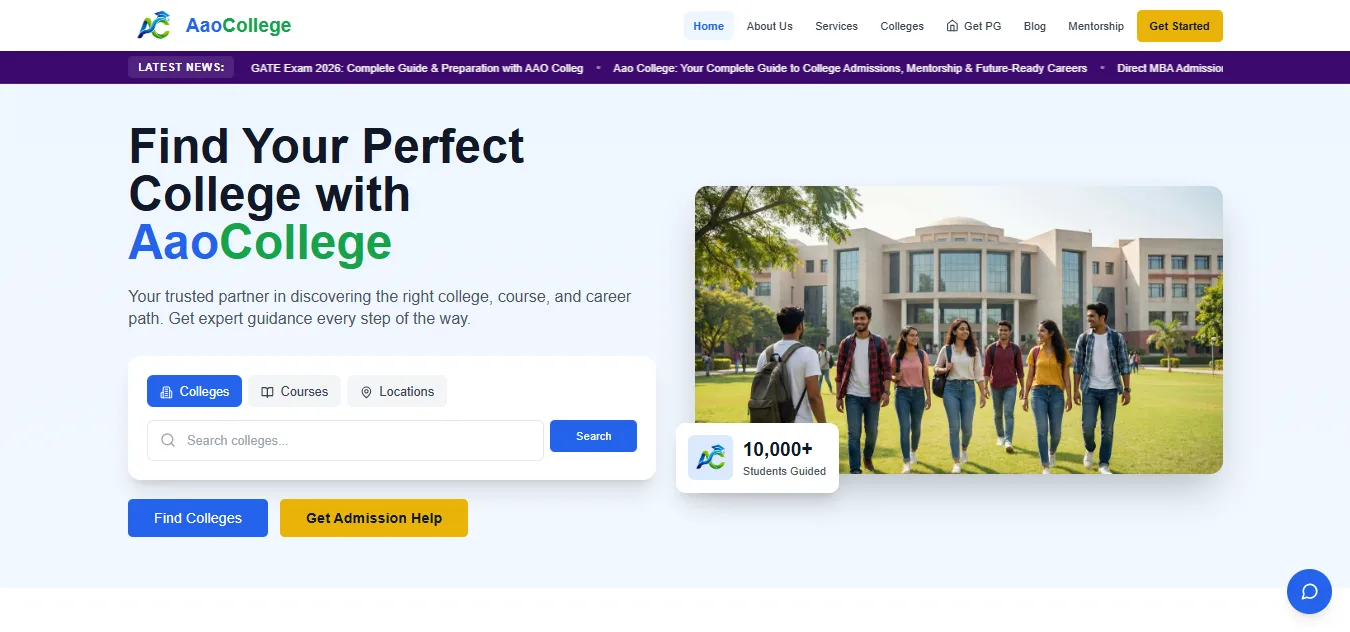
Aao College is an education-focused website that helps students and parents explore courses, admission information, and institutional details through a clear responsive interface.
Target Users
Prospective students, parents, admission counselors, and college staff who need a reliable source for course and admission information.
Purpose
The purpose was to make academic information easier to discover, reduce confusion around admissions, and present the institution with a modern web experience.
Problem Statement
Education websites often bury important course and admission information across cluttered pages, making it difficult for students to compare options or take the next step.
For an institution, unclear information can reduce inquiries and increase repetitive manual follow-up from students and parents.
My Role And Responsibilities
Frontend
- Designed responsive page sections for course discovery, institutional highlights, and admission-focused content.
- Built reusable React components for repeated content blocks such as course cards, feature sections, and calls to action.
Backend
- Structured backend-ready content flows for courses, admission information, and inquiry-oriented data.
- Aligned frontend rendering with predictable data structures to support future CMS or API-backed updates.
Deployment
- Prepared the production build and validated core pages across mobile and desktop devices.
- Checked navigation, links, and inquiry paths after deployment to reduce launch-time friction.
Technical Implementation
Frontend
Used React to compose reusable education-focused sections with clear hierarchy, responsive grids, and accessible navigation patterns.
Backend
Prepared Node.js-oriented data flow patterns for course, admission, and institutional content so the site can scale beyond static content.
Database
Modeled content around MongoDB-friendly entities such as courses, categories, inquiries, and page sections.
Authentication
Public-facing content does not require user authentication, while the architecture can support protected admin editing later.
API Architecture
Content was organized by feature area, making it straightforward to add API endpoints for courses, inquiries, and announcements.
Reusability And Components
Course cards, CTA blocks, and information panels were structured as repeatable components for future department pages.
State Management
Kept interaction state local and minimal so navigation remains fast and predictable for first-time visitors.
TypeScript Usage
Implemented in JavaScript with consistent object shapes and component boundaries to support future migration to TypeScript.
Architecture Overview
Frontend
React
Backend
Node.js-ready content/API layer
Database
MongoDB-ready content model
Deployment
Production web hosting with responsive static delivery
Challenges And Solutions
Challenge 1
Balancing marketing content, course details, and admission information without overwhelming visitors.
Solution
Created a clearer page hierarchy with short summaries, grouped sections, and repeated calls to action at natural decision points.
Challenge 2
Keeping the design usable for students browsing from mobile devices.
Solution
Prioritized mobile-first spacing, readable type sizes, and stacked content flows that preserve scanability on small screens.
Challenge 3
Preparing the site for future dynamic content without overengineering the first release.
Solution
Separated content data from presentation patterns so course and admission sections can later connect to APIs or a CMS.
Performance And Optimization
Lazy Loading
Deferred non-critical visual assets and kept the main content path lightweight for faster first-page rendering.
Code Splitting
Used route and component boundaries to keep the initial interface lean.
Image Optimization
Compressed and sized education visuals for predictable rendering across breakpoints.
Lighthouse And SEO
Validated page responsiveness, readable structure, and interaction flow during production checks.
Improved semantic headings, descriptive page copy, and internal linking for course and admission discoverability.
Deployment And DevOps
Hosting
Deployed to production hosting appropriate for a public institutional website.
Environment Variables
Kept deployment configuration simple and ready for future API or CMS environment variables.
Docker
Docker is not required for the current public site, but the architecture can support containerized services later.
CI/CD
The release flow supports repeatable production updates as course content changes.
Production Considerations
- Verified key navigation paths from homepage to admission and course content.
- Checked mobile rendering and link behavior after launch.
Results And Impact
Outcomes
- Improved course and admission information clarity for prospective students.
- Created a more professional institutional web presence.
- Reduced friction in browsing important college information from mobile devices.
User Experience Improvements
- Visitors can scan course and admission information faster.
- Responsive sections make important content easier to read on phones and tablets.
Reusable And Scalable Design Notes
Modular Structure
Reusable content sections make it easier to add departments, course pages, and admission updates.
Maintainability
Separated copy, UI sections, and route structure reduce the cost of ongoing content updates.
Scalability Notes
- Course listing patterns can be extended into a searchable catalog.
- Inquiry and admission paths can be connected to backend workflows without redesigning the public pages.
Need A Similar Product Build?
If you are planning a project like this, I can help you move from concept to production with practical engineering and clean delivery.