Indian Trade Mart
A dynamic web platform designed for seamless product listing, management, and trade between businesses.
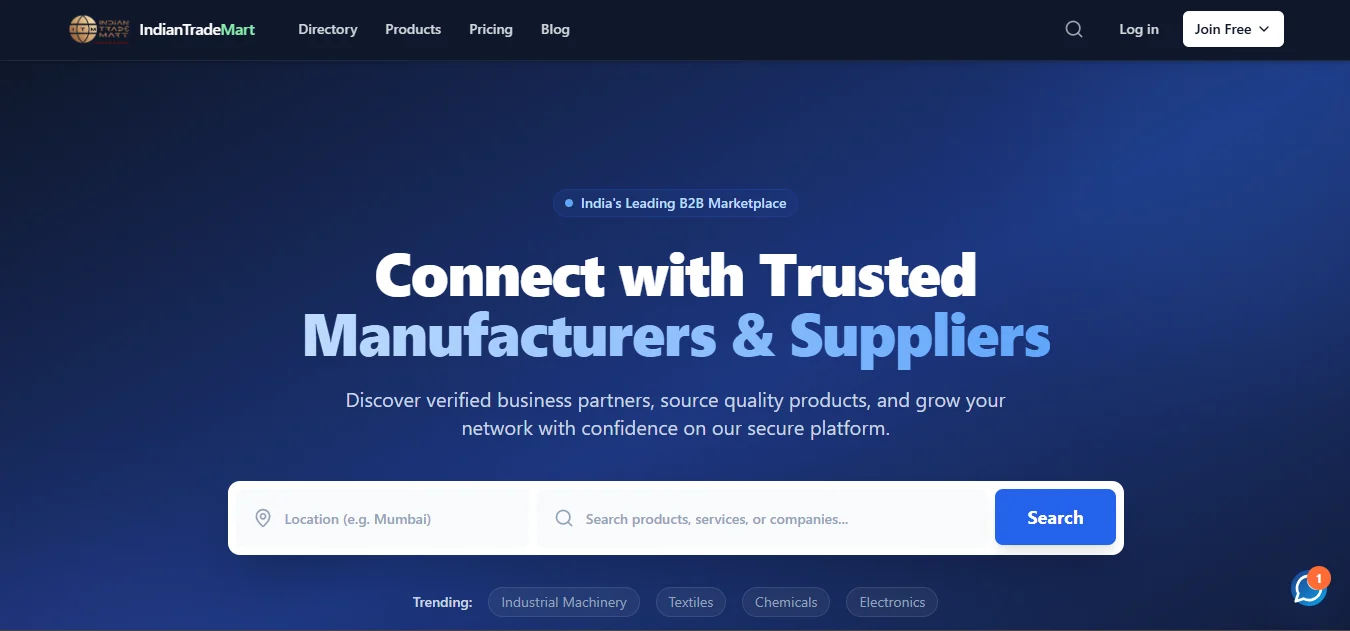
Project Overview
What It Does
Indian Trade Mart is a B2B platform where businesses can list products, manage inventory-ready catalogs, and support trade conversations in a streamlined workflow.
Target Users
Manufacturers, wholesalers, trading teams, and business operators managing product discovery and lead workflows.
Purpose
The goal was to reduce friction in business listing and inquiry handling through a fast, clean, and scalable web platform.
Problem Statement
Many business directories have cluttered interfaces, slow workflows, and poor data consistency across listings and inquiries.
When product information is hard to find or unreliable, businesses lose qualified leads and response time increases.
My Role And Responsibilities
Frontend
- Built responsive listing and discovery interfaces with reusable React components.
- Implemented filter and navigation patterns to keep product exploration fast and intuitive.
Backend
- Integrated API workflows for listing management, category handling, and inquiry actions.
- Supported data validation and structured server responses for predictable rendering.
Deployment
- Prepared production builds and environment-based configuration for stable rollout.
- Validated end-to-end behavior after deployment and handled post-release fixes.
Technical Implementation
Frontend
Used React and Next.js patterns for modular UI, reusable cards, and responsive layout decisions tailored to business users.
Backend
Implemented server workflows for listing data, query handling, and request validation to keep operations consistent.
Database
Used SQL-backed schema design to maintain structured business, category, and listing relationships.
Authentication
Protected internal actions and sensitive workflows using secured request patterns where needed.
API Architecture
Feature-based API endpoints were organized by listing, category, and inquiry modules with consistent response shapes.
Reusability And Components
Created reusable cards, badges, and grid sections to accelerate future feature development.
State Management
Handled local and section-level state with predictable update flows for filters and content rendering.
TypeScript Usage
This version uses JavaScript with strict component boundaries and consistent data-shape handling.
Architecture Overview
Frontend
React + Next.js
Backend
API services for listing and inquiry workflows
Database
SQL
Deployment
Production web hosting with environment variables
Challenges And Solutions
Challenge 1
Rendering large sets of business listings while maintaining smooth interaction on lower-end devices.
Solution
Optimized card rendering strategy, improved UI composition, and reduced unnecessary updates in filtered views.
Challenge 2
Keeping listing data consistent between management workflows and public-facing pages.
Solution
Used schema-aware validation and clear API contracts to minimize data mismatch issues.
Challenge 3
Balancing detailed business information with a clean discovery experience.
Solution
Introduced hierarchy-focused UI decisions with concise preview cards and progressive details.
Performance And Optimization
Lazy Loading
Deferred non-critical visual blocks and media-heavy areas to improve first contentful render.
Code Splitting
Applied route-level splitting to keep initial bundle size lean for first-time visitors.
Image Optimization
Standardized image sizes and rendering behavior for listing thumbnails across breakpoints.
Lighthouse And SEO
Performance and accessibility were optimized iteratively through Lighthouse checks.
Improved metadata structure, semantic hierarchy, and readable content sections for search discoverability.
Deployment And DevOps
Hosting
Deployed on production web hosting aligned with client infrastructure requirements.
Environment Variables
Configured runtime variables for API URL, keys, and environment-specific integration behavior.
Docker
Containerization is optional and can be introduced without redesigning the architecture.
CI/CD
Release flow supports repeatable production deployment with verification checks before launch.
Production Considerations
- Validated key business workflows after each release.
- Monitored runtime behavior and resolved high-priority defects quickly.
Results And Impact
Outcomes
- Improved discoverability of product listings and inquiry-ready pages.
- Reduced friction in business listing updates and category-level organization.
- Delivered a cleaner and faster user experience for trade-focused navigation.
User Experience Improvements
- Clear section hierarchy improved scanability for users with large product catalogs.
- Mobile responsiveness increased usability for on-the-go business users.
Reusable And Scalable Design Notes
Modular Structure
Feature modules and reusable UI components allow the platform to scale by category, vendor type, and workflow complexity.
Maintainability
Consistent component and API structure makes onboarding and future refactoring faster.
Scalability Notes
- Shared UI blocks reduce duplication across listing and detail screens.
- Data flow separation makes future enhancements safer and easier to test.
Need A Similar Product Build?
If you are planning a project like this, I can help you move from concept to production with practical engineering and clean delivery.