Startup and Business India
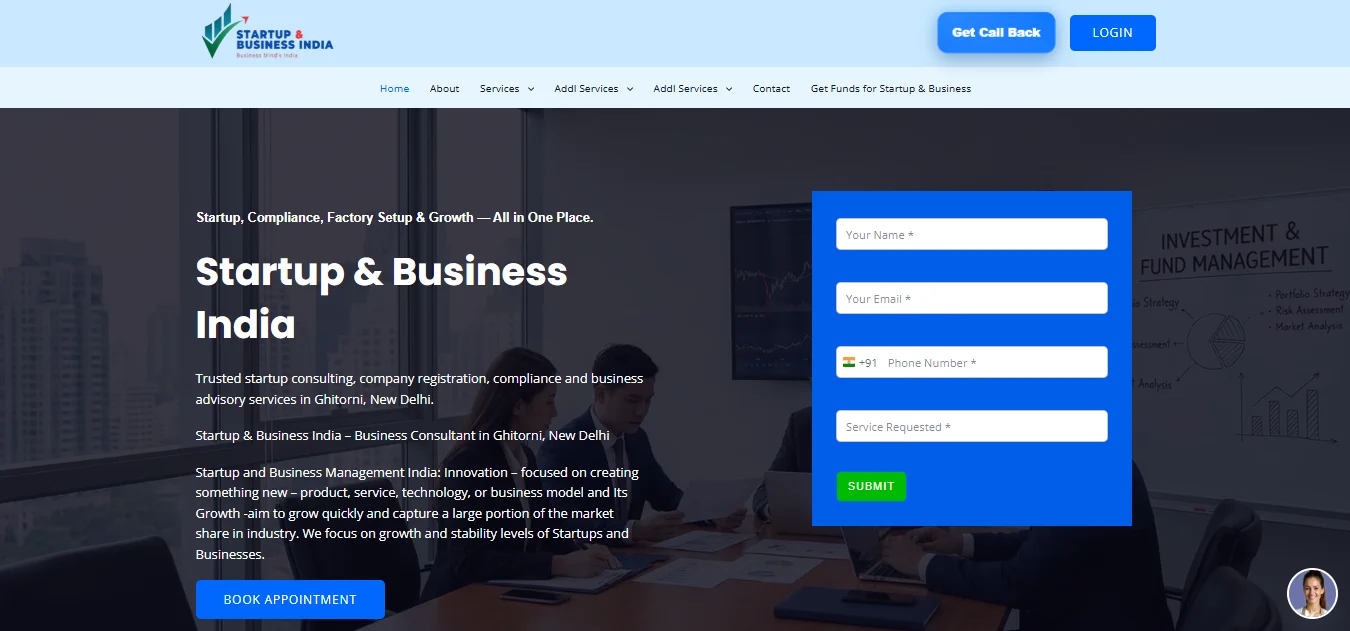
A WordPress business website built to showcase startup services and generate qualified leads.
Project Overview
What It Does
Startup and Business India is a service-focused WordPress website built to explain business offerings, guide visitors through service categories, and make inquiries easier.
Target Users
Startup founders, small business owners, consultants, and service buyers looking for business setup or growth support.
Purpose
The goal was to create a clearer public website that communicates services quickly and turns interested visitors into qualified inquiries.
Problem Statement
Service businesses often lose potential leads when visitors cannot quickly understand the offer, trust signals, or next step.
A clear service website can reduce sales friction by answering common questions before the first conversation.
My Role And Responsibilities
Frontend
- Built service-first landing sections with clear headings, calls to action, and readable content hierarchy.
- Customized Elementor layouts so non-technical content updates can happen faster after launch.
Backend
- Configured WordPress page structures, theme behavior, and PHP-backed content management patterns.
- Prepared reusable service blocks that can be extended without rebuilding page layouts from scratch.
Deployment
- Supported production setup, plugin checks, and live-page validation after launch.
- Verified service pages, contact paths, and responsive behavior across common screen sizes.
Technical Implementation
Frontend
Used Elementor and custom styling decisions to create service pages that are easy to scan and aligned with business conversion goals.
Backend
Used WordPress and PHP as the content management foundation, allowing service copy and page sections to be maintained after delivery.
Database
Relied on WordPress database structures for pages, media, settings, and reusable content sections.
Authentication
Kept public browsing open while limiting content editing to WordPress admin users.
API Architecture
The site uses WordPress-managed content flow rather than a custom API, which fits the business website scope.
Reusability And Components
Reusable Elementor sections help keep service pages visually consistent and easier to update.
State Management
The website uses mostly static service content with form and navigation interactions handled through WordPress and client-side behavior.
TypeScript Usage
This project uses WordPress, PHP, and JavaScript rather than TypeScript because the priority was maintainable content management.
Architecture Overview
Frontend
WordPress + Elementor
Backend
PHP + WordPress CMS
Database
WordPress database
Deployment
Production WordPress hosting
Challenges And Solutions
Challenge 1
Making multiple service offerings understandable without creating long, difficult-to-scan pages.
Solution
Grouped services into focused sections with concise copy, supporting details, and repeated inquiry paths.
Challenge 2
Keeping the design editable for the business team after delivery.
Solution
Used Elementor sections and WordPress-managed content patterns instead of hardcoding every content block.
Challenge 3
Balancing visual presentation with page speed on a plugin-based WordPress stack.
Solution
Kept layouts focused, avoided unnecessary heavy sections, and optimized assets used in public pages.
Performance And Optimization
Lazy Loading
Used lightweight section composition and image handling to reduce unnecessary page weight.
Code Splitting
Kept page templates focused so plugin and theme output stays manageable.
Image Optimization
Compressed and reused visual assets across service sections to reduce repeated downloads.
Lighthouse And SEO
Checked page quality and responsiveness during launch preparation.
Improved service page structure, descriptive headings, internal navigation, and conversion-focused copy.
Deployment And DevOps
Hosting
Deployed on WordPress-compatible production hosting with standard CMS administration.
Environment Variables
Configured the site around production domain, WordPress settings, plugins, and media paths.
Docker
Docker was not required for the WordPress delivery workflow.
CI/CD
Updates are managed through WordPress content workflows and verified after publishing.
Production Considerations
- Checked key service pages and contact routes after deployment.
- Validated responsive layouts and admin-editable content sections.
Results And Impact
Outcomes
- Created clearer service communication for startup and business visitors.
- Improved inquiry readiness through focused calls to action.
- Made content updates easier through reusable WordPress and Elementor structures.
User Experience Improvements
- Visitors can understand service categories with less scrolling and confusion.
- The content structure supports faster scanning before contacting the business.
Reusable And Scalable Design Notes
Modular Structure
Reusable Elementor blocks make it easier to add future services, landing pages, and campaign sections.
Maintainability
WordPress-managed content keeps routine updates accessible without developer involvement.
Scalability Notes
- Service pages can be expanded into separate SEO landing pages.
- Lead forms and analytics can be improved later without changing the site foundation.
Need A Similar Product Build?
If you are planning a project like this, I can help you move from concept to production with practical engineering and clean delivery.