Todo App
A task management web app that helps users organize, track, and manage daily tasks efficiently.
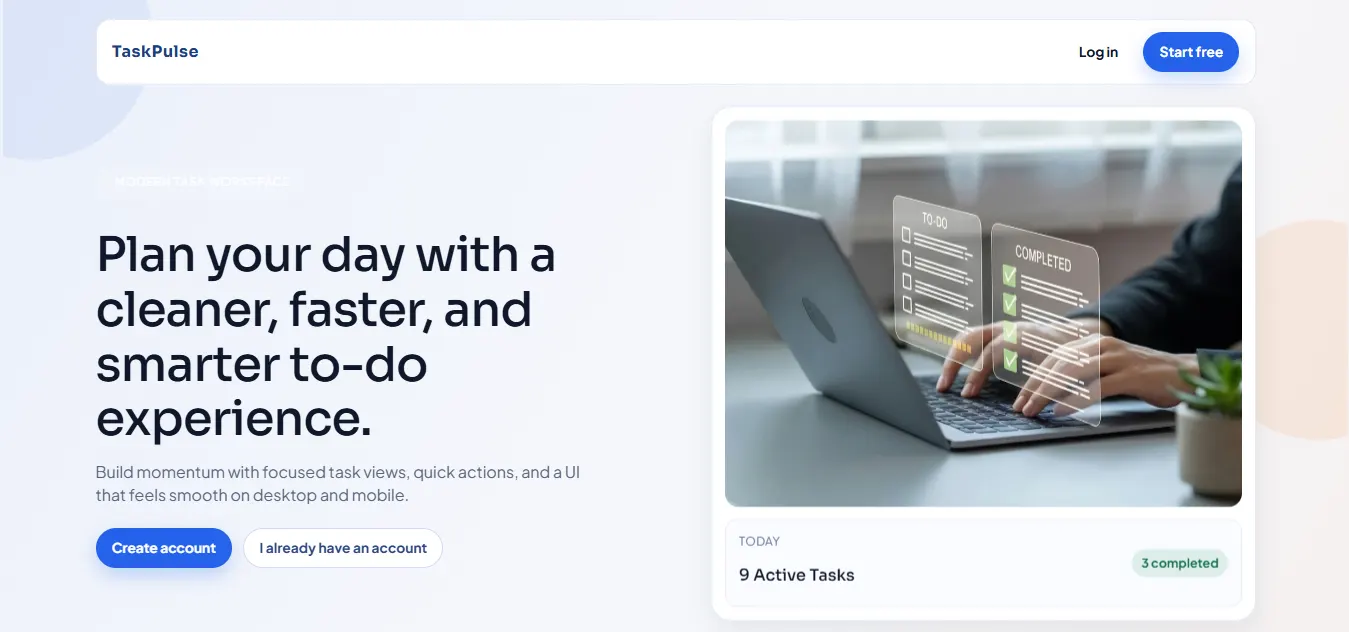
Project Overview
What It Does
Todo App is a MERN-based productivity platform for creating, updating, and tracking daily tasks with a clean and responsive interface.
Target Users
Students, professionals, and individual users who need lightweight daily task management.
Purpose
To deliver a full-stack reference project that demonstrates robust CRUD behavior and clean frontend-backend integration.
Problem Statement
Simple task tools often miss persistence, filtering flexibility, and smooth state updates across devices.
Without reliable task tracking and quick interactions, users lose productivity and trust in the workflow.
My Role And Responsibilities
Frontend
- Built React task interfaces with reusable list, item, and filter components.
- Implemented interactive UX for create, update, complete, and delete actions.
Backend
- Developed Node.js and Express APIs for CRUD operations and data validation.
- Implemented API response handling to keep task state synchronization reliable.
Deployment
- Deployed frontend and backend services with environment-specific configuration.
- Verified integration behavior in production and fixed deployment edge cases.
Technical Implementation
Frontend
Used React components and controlled forms to deliver a fast and predictable task interaction experience.
Backend
Built REST APIs with Node.js and Express to support task creation, updates, deletion, and status handling.
Database
Integrated MongoDB for flexible task schema, persistent storage, and reliable retrieval.
Authentication
Authentication is optional for this version; architecture supports adding user-based authorization.
API Architecture
Organized REST endpoints by task actions with standardized request and response structures.
Reusability And Components
Component-first architecture allows task cards, filters, and action controls to be reused easily.
State Management
Used React state patterns and API-driven updates to keep UI in sync after each operation.
TypeScript Usage
Implemented in JavaScript; component structure and API contracts are kept strict for easy migration.
Architecture Overview
Frontend
React
Backend
Node.js + Express
Database
MongoDB
Deployment
Frontend and backend deployed as separate production services
Challenges And Solutions
Challenge 1
Ensuring frontend state stays consistent immediately after asynchronous CRUD requests.
Solution
Introduced predictable update flows and centralized API success/error handling for task actions.
Challenge 2
Handling edge cases around empty states, rapid updates, and status toggles.
Solution
Added guard conditions and clear UI feedback for each task operation path.
Challenge 3
Keeping deployment configuration stable across local, staging, and production environments.
Solution
Used environment variables for service URLs and validated integration behavior post-release.
Performance And Optimization
Lazy Loading
Loaded non-critical views lazily to keep primary task interactions quick.
Code Splitting
Applied route-level code splitting to minimize initial bundle footprint.
Image Optimization
Kept visual assets lightweight and optimized to avoid blocking interaction.
Lighthouse And SEO
Performance quality was improved through repeated Lighthouse-guided tuning.
Applied semantic markup and metadata improvements for cleaner indexing of public-facing content.
Deployment And DevOps
Hosting
Frontend hosted on Vercel with backend deployed on a compatible Node runtime.
Environment Variables
Configured runtime variables for API base URL and environment-specific service settings.
Docker
Docker not required in the current release, but architecture supports containerized deployment.
CI/CD
Deployment pipeline supports repeatable builds and quick production updates.
Production Considerations
- Monitored API availability and validated task persistence under real usage.
- Improved failure handling to keep UX stable during network interruptions.
Results And Impact
Outcomes
- Delivered a stable full-stack CRUD implementation with persistent data.
- Improved task management flow through faster state updates and clear interaction design.
- Built a reusable project foundation for advanced features like auth and collaboration.
User Experience Improvements
- Action feedback and filter flow improved day-to-day usability.
- Mobile-first responsiveness improved accessibility across devices.
Reusable And Scalable Design Notes
Modular Structure
Separated task UI, API utilities, and server modules so new features can be added incrementally.
Maintainability
Consistent naming and clear API contracts make debugging and extension faster.
Scalability Notes
- Reusable components simplify adding labels, priorities, and category views.
- Backend route structure supports future authentication and multi-user support.
Need A Similar Product Build?
If you are planning a project like this, I can help you move from concept to production with practical engineering and clean delivery.